Dry January Isn’t About Willpower; It’s a Sleep & Nervous System Experiment
Medical disclaimer: This article is for general education only, not medical advice. If you have a medical condition, take medication, are pregnant, or have persistent sleep or mental health symptoms, talk to a qualified clinician. If you drink heavily or daily, do not stop suddenly without medical guidance, alcohol withdrawal can be dangerous.
Dry January has become a global reset button: 31 days off alcohol to reflect, re-balance, and start the year differently.
But for many, the real game-changer is the impact on Dry January sleep quality and nervous system regulation. The challenge was developed and is delivered by Alcohol Change UK. Alcohol Change UK+1
But here’s the perspective most people miss:
Dry January isn’t primarily a willpower test. It’s a nervous system and sleep experiment.
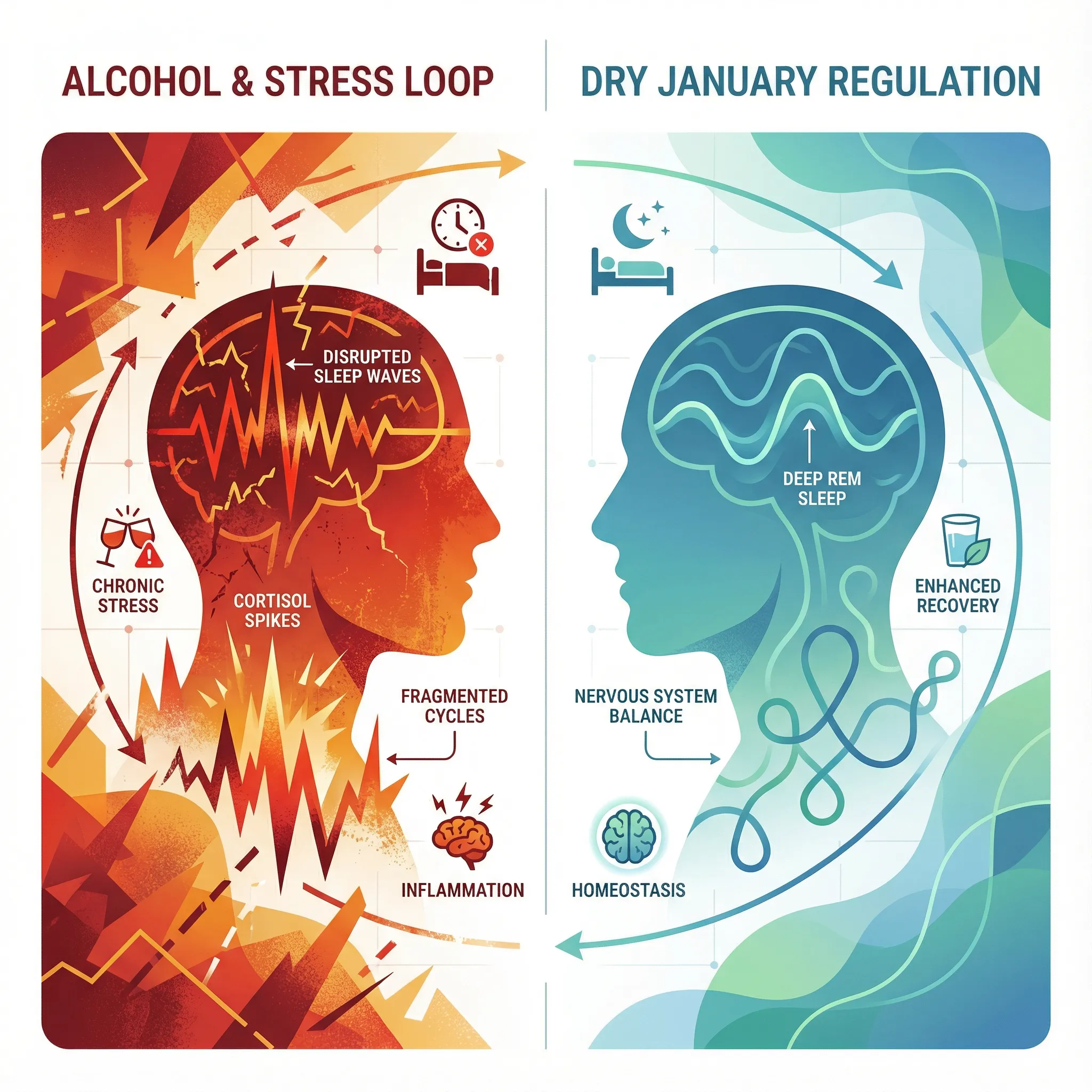
Because alcohol doesn’t just affect “how you feel.” It affects how your body downshifts at night, how you recover, and how steady your energy is the next day.
What’s the real goal of Dry January?
If your goal is only “prove I can stop,” you’ll tend to:
- white-knuckle cravings,
- count down days,
- and rebound hard in February.
A more useful goal is:
Learn what alcohol has been doing to your sleep, stress response, mood, and energy; then choose what you want next.
That mindset change is what turns Dry January into lasting insight instead of a temporary restriction.
Does alcohol really affect sleep quality?
Yes, consistently enough that major sleep education resources highlight the pattern: alcohol can make you feel sleepy, but it tends to reduce restorative sleep and increase disruption later in the night. Sleep Foundation
Research also shows dose-dependent effects on sleep architecture (including REM sleep changes) and fragmentation. A 2025 paper reviewing effects of alcohol on subsequent sleep in healthy adults reports negative impacts on REM sleep, and notes that higher doses may shorten sleep onset while worsening later disruption. ScienceDirect
Translation: falling asleep faster isn’t the same as sleeping better.
When do people notice benefits in Dry January?
Many participants report improvements like sleep, mood, and energy during a month off alcohol. A December 2025 summary from Brown University (School of Public Health) describes reported benefits among participants -including improved sleep and mood- during Dry January-style abstinence. sph.brown.edu
An earlier medical overview of the campaign similarly describes common participant-reported benefits (sleep and energy among them), while also noting the need for strong evidence and careful interpretation. PMC
Important: Self-reported benefits are valuable signals—but they’re not the same as a clinical guarantee. Your experience will depend on your baseline sleep, stress load, drinking pattern, and overall health.
Who is Dry January for, and who should take extra care?
Dry January may be a good fit if you:
- drink socially or moderately and want to reset habits
- notice alcohol affects your sleep, mood, anxiety, or energy
- want a structured way to reduce “default drinking” in January
Pause and talk to a clinician first if you:
- drink heavily or daily
- have had withdrawal symptoms before (shaking, sweating, agitation, fast heartbeat, nausea, confusion)
- have a history of substance use disorder
- take medications that interact with alcohol or affect the nervous system
Why this matters: Alcohol withdrawal can be medically serious for some people. Safety comes first.
The thought-leadership lens: “regulation,” not restriction
At Thera Wellness we talk about regulation as the body’s ability to adapt and return toward balance. In practice, a month off alcohol can reveal whether your system:
- downshifts more easily at night
- stabilizes energy across the day
- becomes less reactive to stress
Instead of “I’m being good,” the experiment becomes:
“What helps my system recover?”
A realistic 31-day plan that doesn’t rely on willpower
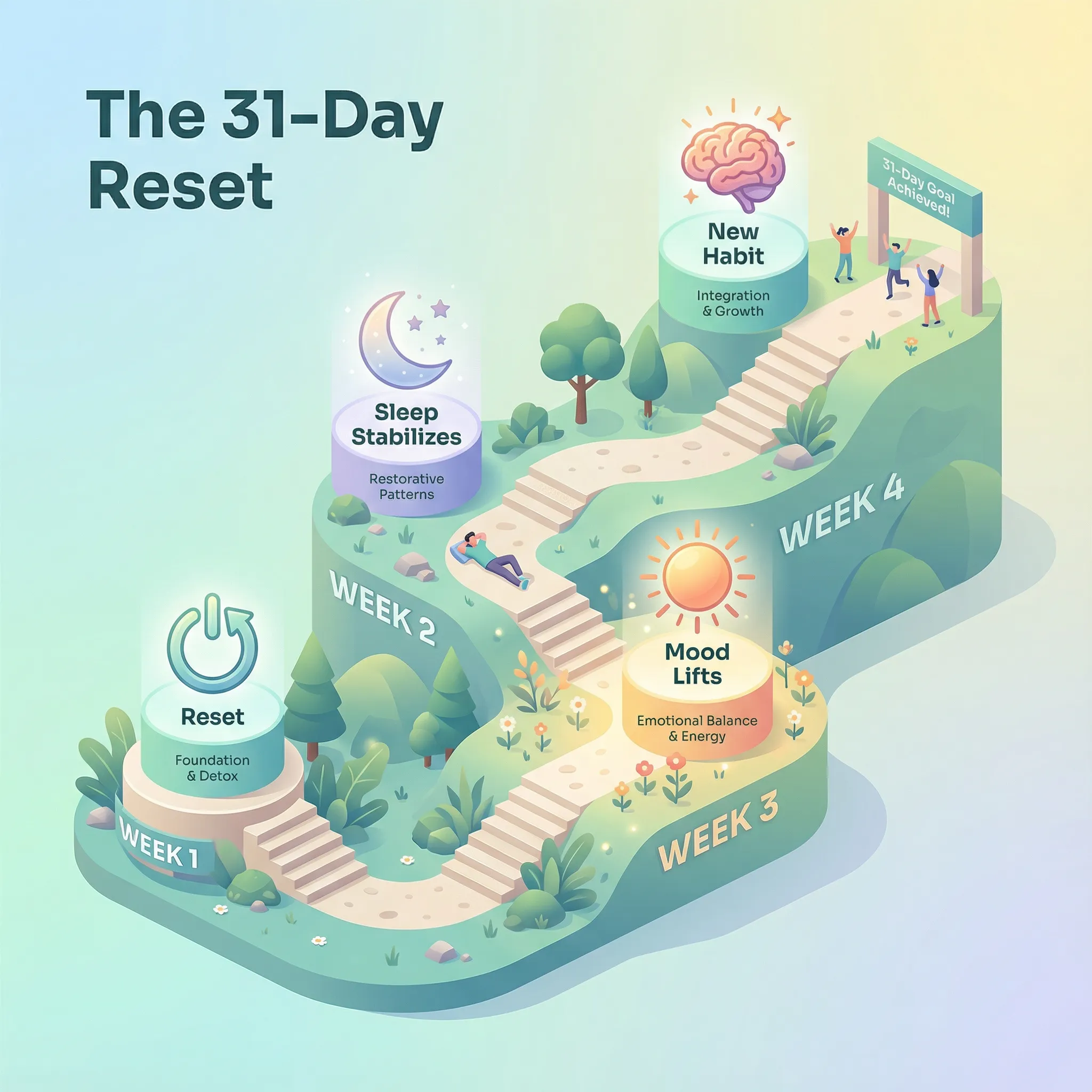
Step 1: Pick your why (one sentence)
Examples:
- “I want to sleep deeper.”
- “I want steadier energy.”
- “I want to break the ‘drink to decompress’ loop.”
Write it somewhere visible. Your brain needs a target.
Step 2: Choose your “replacement ritual”
Alcohol often serves a job: transition, reward, social ease, stress relief.
Pick one replacement ritual you’ll use most nights:
- sparkling water + citrus + salt (a “grown-up” ritual)
- tea + 10-minute wind-down playlist
- warm shower + dim lights
- short walk after dinner
- non-alcoholic cocktail (if that supports you)
Step 3: Use “if–then planning” (the science of making it stick)
Implementation intentions (“if–then plans”) are a well-studied behavior change strategy: you pre-decide what you’ll do in a predictable trigger situation. Taylor & Francis Online
Try 3–5 of these:
- If it’s 6 pm and I feel stressed, then I’ll do 3 minutes of slow breathing before deciding what to drink.
- If friends suggest drinks, then I’ll say: “I’m doing a January reset—let’s do coffee / a walk / dinner.”
- If I’m bored at night, then I’ll make a hot drink and read for 10 minutes.
- If I’m craving alcohol after a long day, then I’ll eat something protein-forward first and reassess in 20 minutes.
This is not about being rigid, it’s about removing decision-fatigue.
What should you track during Dry January (so you learn something)?
Pick three signals, not fifteen:
1) Sleep continuity
- time to fall asleep
- wake-ups
- how rested you feel
2) Mood stability
- anxiety level (0–10)
- irritability (0–10)
- “stress recovery time” (how long you stay activated)
3) Energy consistency
- morning energy (0–10)
- afternoon crash (yes/no)
- cravings (when they happen)
Optional: If you use a wearable, treat sleep/HRV as trend information, not a diagnosis.
What if your sleep gets worse at first?
Some people notice:
- vivid dreams
- restless evenings
- irritability in week one
That doesn’t mean Dry January “isn’t working.” It may mean your body is recalibrating how it downshifts. If sleep disruption is severe, persistent, or tied to anxiety/panic symptoms, loop in a clinician.
The most common hidden benefit: breaking the “stress → drink” reflex
Even when alcohol is occasional, it can become a default transition:
- hard day → drink
- social discomfort → drink
- celebration → drink
- boredom → drink
Dry January gives you a month to build new transitions—and those transitions are the real long-term win.
When to get professional support immediately
Seek urgent help if you experience:
- confusion, seizures, hallucinations
- severe shaking, vomiting, or rapid heartbeat after stopping alcohol
- suicidal thoughts or inability to function
If you’re in doubt, treat it as medical.
FAQ
Is Dry January safe for everyone?
Not always. If you drink heavily or daily, stopping suddenly can be unsafe. Talk to a clinician before changing alcohol use.
How fast can sleep improve without alcohol?
Many people report sleep improvements during a month off alcohol, but timing varies. Alcohol can disrupt sleep quality even if it helps with falling asleep. Sleep Foundation+1
What should I drink instead of alcohol at night?
Choose a replacement ritual you actually enjoy (sparkling water, tea, a crafted non-alcoholic drink). The goal is to keep the “wind-down cue” without alcohol.
What’s the best strategy for cravings?
Use if–then plans for your most predictable trigger moments (after work, social invites, boredom). This strategy is strongly supported in behavior-change research. Taylor & Francis Online
If I don’t do 100% abstinence, is it still worth it?
For some people, cutting down is a meaningful step. But if your aim is a clear sleep/nervous system experiment, full abstinence for 31 days makes your “signal” easier to read.
Disclaimer:
This information is for educational purposes only and does not constitute professional medical advice. Always consult a healthcare professional before incorporating any new therapy into your practice.
Do you want to see all the updates?
👉 Follow us on Instagram and Facebook and never miss a thing!