Burnout vs. Depression: Are They Separate Disorders or the Same Condition? What Research Actually Shows
Mental health professionals and researchers have long debated whether burnout and depression are distinct psychological conditions or simply different manifestations of the same underlying disorder.
This question matters, not just for academic precision, but for how we diagnose, treat, and ultimately support people struggling with psychological distress in their work lives. Let’s dive into what the latest empirical research tells us.
The Great Overlap: Why the Confusion Exists
Burnout and depression do share striking similarities. Both involve emotional exhaustion, loss of interest in activities, and impaired concentration. Both can emerge from chronic stress and significantly impact quality of life.
For decades, researchers and clinicians have asked: Are we looking at two sides of the same coin, or distinct conditions requiring different treatments?
The stakes of this question are high. If burnout is simply depression masquerading as work-related distress, then treating it as a unique occupational condition could be misguided. Conversely, if burnout is distinct, missing that distinction could mean overlooking the specific workplace factors driving people’s suffering.

What the Numbers Show: The Correlation Debate
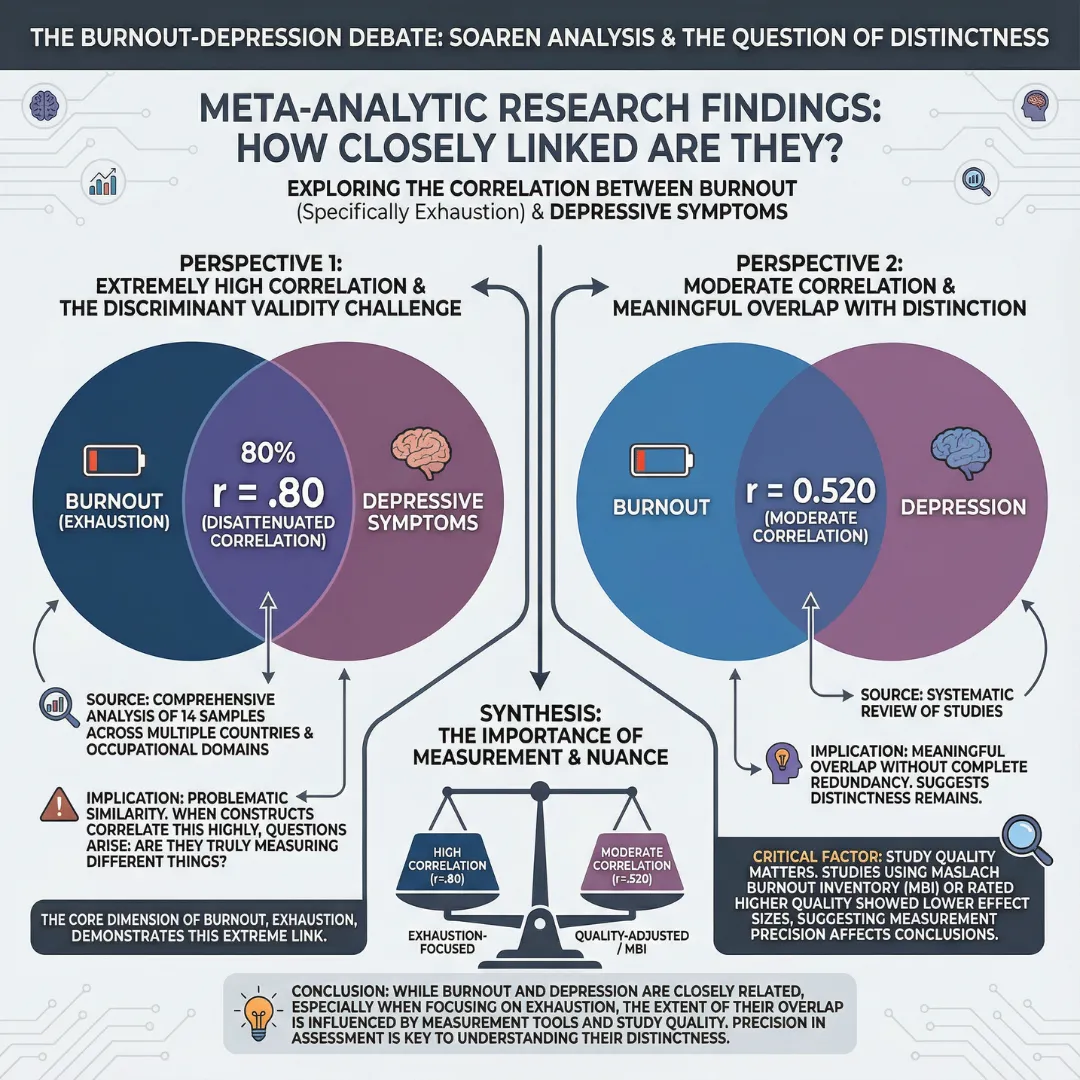
Recent meta-analytic research has produced sobering findings about the close link between burnout and depression. A comprehensive analysis examining 14 samples across multiple countries and occupational domains found that exhaustion, the core dimension of burnout, demonstrates an extremely high correlation with depressive symptoms. Specifically, researchers found a disattenuated correlation of r = .80, suggesting that exhaustion and depression are problematically similar from a discriminant validity perspective.
This isn’t a small relationship. In statistical terms, when two constructs correlate that highly, questions naturally arise about whether they’re truly measuring different things.
However, other meta-analyses paint a slightly different picture. A systematic review examining studies found a moderate correlation between burnout and depression of r = 0.520. While still substantial, this relationship suggests meaningful overlap without complete redundancy. Notably, this same research found that study quality mattered; studies using the Maslach Burnout Inventory (MBI) or rated as higher quality showed lower effect sizes, suggesting that measurement precision affects our conclusions.
The Case for Distinction: A Shared Foundation with Unique Features
Recent research has challenged the notion that burnout and depression are the same condition. A bifactor analysis across four countries and multiple patient samples revealed something nuanced: while burnout and depression share a strong underlying factor, general psychological distress, they also maintain distinctive specific factors.
Think of it this way: both conditions sit atop a foundation of psychological distress (the shared element), but they express themselves differently. The research found that “although both conditions share common ground (i.e., psychological distress), they are not redundant”.
One particularly intriguing finding: the same study suggested that suicidal ideation may represent a distinctive core component of depression that distinguishes it from burnout. This matters clinically; it suggests depressive disorders carry a different risk profile than occupational burnout.
The Depression Framework: Beyond Work
To understand the distinction, it helps to recognize how researchers conceptualize depression versus burnout. Depression encompasses a broad cluster of affective, cognitive, behavioral, and somatic symptoms, including dysphoric mood and anhedonia, that can arise from multiple sources. Importantly, depression is dimensional; it exists on a continuum with only those at the highest end meeting diagnostic criteria.
Burnout, by contrast, is defined as inherently occupational. It’s characterized specifically by emotional exhaustion, cynicism, and reduced personal accomplishment in work contexts. The key distinction: burnout assessment tools are “cause-specific,” focusing on work-related stressors as the etiology, while depression measures are typically cause-neutral.
When Workplace Stress Becomes Depression
Here’s a critical finding from longitudinal research: workplace stressors themselves are related to increased depressive symptoms and elevated risk of depressive disorders. This suggests a potential pathway: chronic work stress can lead to burnout, which, when unaddressed, may in turn develop into clinical depression. The evidence indicates that unresolvable work stress, situations where individuals feel helpless and trapped in the face of negative events perceived as uncontrollable, functions as a potent depressogenic factor. This bridges burnout and depression conceptually.
Implications for You: What This Means in Practice
So what’s the bottom line for someone experiencing emotional exhaustion at work?
Both conditions deserve treatment. Whether your struggles are narrowly “burnout” or more broadly “depression,” they warrant professional attention. The research consensus is clear: these conditions significantly impact mental health and well-being.
The context matters. If your distress is primarily work-related and centres on exhaustion, cynicism about your job, and reduced effectiveness, burnout-specific interventions (like workplace changes, stress management, or occupational counselling) may be particularly valuable.
But monitor for depression. If you notice broader symptoms, such as persistent sadness, loss of interest in things you once enjoyed outside work, sleep changes, or especially any thoughts of self-harm, seek evaluation for depression specifically.
Get a professional assessment. A mental health professional can help distinguish whether you’re experiencing occupational burnout, depression, or both. This distinction can guide treatment selection.
The Research Consensus: Overlapping but Distinguishable
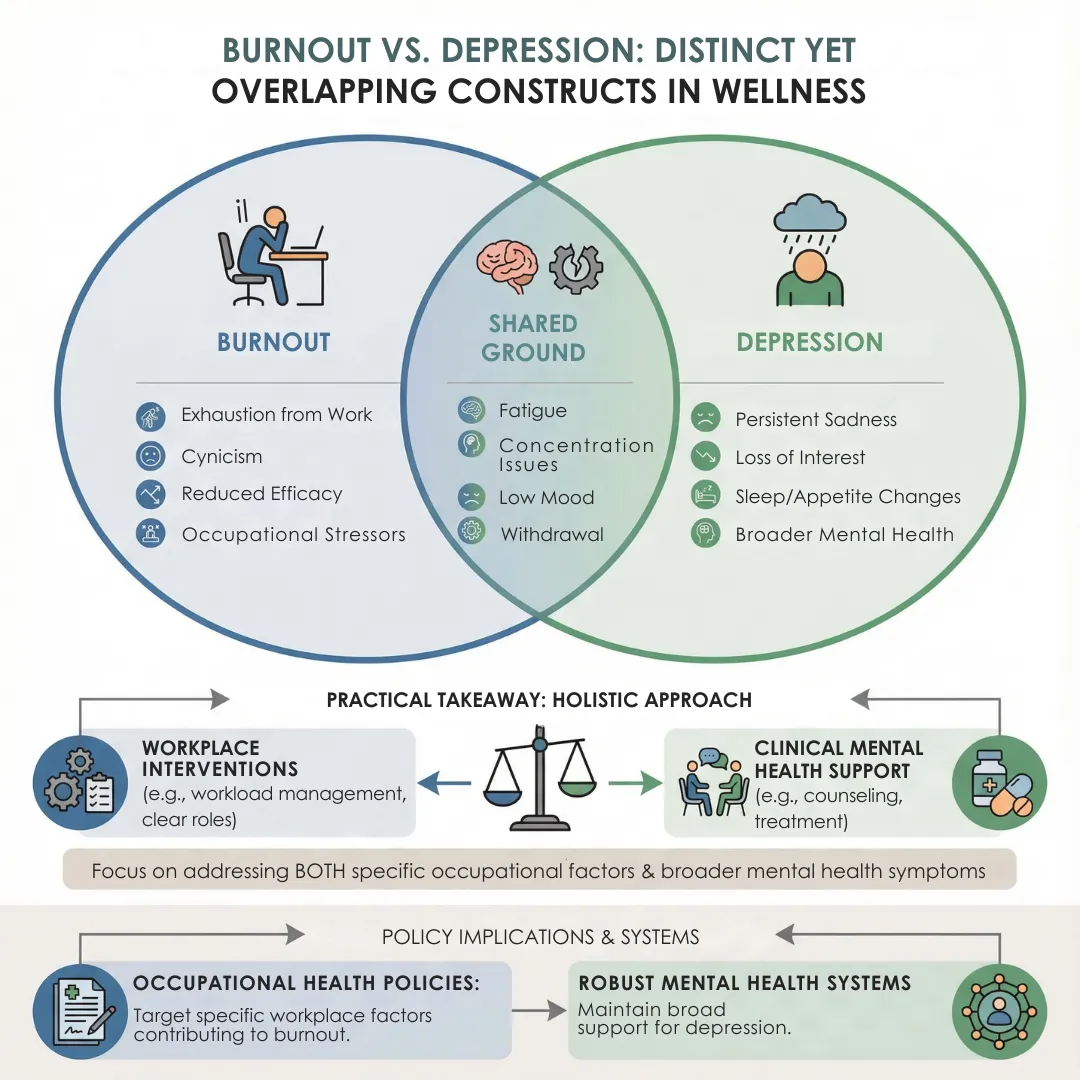
The emerging research consensus suggests a middle ground: burnout and depression are distinct constructs that substantially overlap. They’re like two overlapping circles in a Venn diagram rather than identical circles. They share significant common ground, but each has unique features worth recognizing.
The practical takeaway? Don’t get too caught up in whether your condition is “really” burnout or “really” depression. Instead, focus on addressing both the specific occupational factors (if applicable) and the broader mental health symptoms. Effective treatment might require both workplace interventions and clinical mental health support.
The research also reminds us that this distinction has implications beyond individual care; it suggests we need occupational health policies and interventions targeting the specific workplace factors that contribute to burnout, even as we maintain robust mental health support systems for depression more broadly.
Further Reading
- Burnout and Depression: Two Entities or One?
- Burnout–depression overlap: A review
- The Relationship Between Burnout, Depression, and Anxiety: A Systematic Review and Meta-Analysis
- Comparative symptomatology of burnout and depression
Disclaimer:
This information is for educational purposes only and does not constitute professional medical advice. Always consult a healthcare professional before incorporating any new therapy into your practice.
Do you want to see all the updates?
👉 Follow us on Instagram and Facebook and never miss a thing!