Why Children with Sensory or Behavioral Challenges May Need a More Regulatory Approach
Understanding Sensory Challenges and Behavior
When a child melts down in a grocery store, refuses certain clothes, shuts down in noisy environments, or seems constantly “on edge,” adults often focus first on the visible behavior. But in many cases, what looks like defiance, inattention, or overreaction may actually signal dysregulation. For some children, the issue is not simply behavior control; their nervous system is struggling to process input, recover from stress, or maintain a state that supports attention, flexibility, and participation. A more regulatory approach starts from that possibility.
Sensory difficulties are common across a range of developmental and behavioral presentations, including autism, ADHD, anxiety, developmental coordination problems, and other neurodevelopmental or psychiatric concerns. The American Academy of Pediatrics specifically advises clinicians to treat “sensory processing disorder” not as a stand-alone diagnosis but as part of a broader developmental and behavioral evaluation, since sensory symptoms often overlap with other conditions and should be understood in context.
A regulatory approach changes the question from “How do we stop this behavior?” to “What is this child’s system struggling to manage right now?” That shift matters. A child who covers their ears, avoids textures, craves movement, resists transitions, or escalates rapidly may be responding to overload, under-registration, or difficulty modulating arousal rather than choosing to be difficult. Framing the problem through regulation does not excuse harmful behavior, but it can make intervention more accurate, more compassionate, and often more effective.

The Link Between Sensory Reactivity and Emotional Regulation
Sensory reactivity and emotion regulation appear to be meaningfully linked. Recent work has connected sensory-processing patterns with emotional dysregulation and anxiety in neurodevelopmental populations, while earlier prospective research found that sensory over-responsivity can predict later anxiety-related difficulties in children. In practice, that means sensory challenges are not just “quirks.” They may shape how safely and predictably a child experiences daily life.
The Power of Co-Regulation in Early Childhood
For families and practitioners, this is often where co-regulation becomes essential. Children do not develop self-regulation in isolation; they build it through repeated experiences with calm, responsive adults and supportive environments. A recent review on early childhood emotion regulation in autism highlights parent-child co-regulation as a key mechanism in emotional development, and a 2024 study found that stronger behavioral and emotional coregulation during challenge was associated with better child self-regulation.
Implementing a Regulatory Approach: Individualized Support
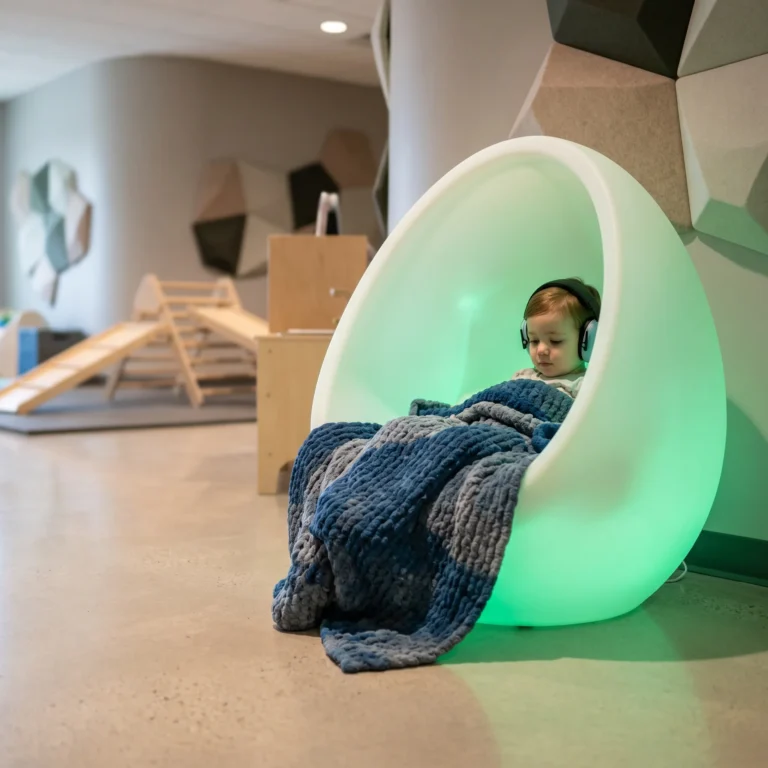
However, not every child with sensory or behavioral challenges needs the same intervention. The starting point should be individualized support for participation and function. Sometimes that looks like environmental modification: reducing noise, adjusting lighting, preparing a child for transitions, using visual supports, or making tasks more predictable. Sometimes it involves occupational therapy, parent coaching, movement-based supports, or targeted sensory strategies. The goal is not to make the child appear compliant at all costs, but rather to help them access daily life with less distress and more capacity.
The research supports a measured, selective approach rather than a one-size-fits-all sensory narrative. The American Academy of Pediatrics has long cautioned that evidence for sensory-based therapies is limited and that pediatricians should help families define clear goals and monitor whether an intervention is actually helping. More recent systematic review evidence is more encouraging in specific areas, suggesting stronger support for deep-pressure tactile input and caregiver training in sensory strategies, with more mixed evidence for other sensory-based techniques.
This nuance is important. It keeps the conversation clinically credible. A regulatory approach is not the same as assuming every struggle is sensory, and it is not a replacement for speech therapy, behavioral therapy, mental health care, developmental assessment, or medical evaluation when those are needed. It simply recognizes that many children cannot learn, communicate, transition, or cope well when their nervous system is overwhelmed. Regulation often needs to come before higher-level demands can succeed.

Real-World Success: Sensory-Informed Adaptation
There are also real-world examples of how sensory-informed adaptation can improve participation in specific settings. Recent reviews in pediatric dentistry, for example, found that sensory-adapted environments and related strategies can reduce distress and improve cooperation for autistic children during dental care. That does not prove that all sensory-based approaches work across all outcomes, but it does show that when environments become more tolerable for a child’s nervous system, participation can improve in meaningful ways.
For holistic and integrative practitioners, this opens an important door. Instead of asking only how to reduce symptoms, it becomes possible to ask how to support the child’s state. Is the environment too loud, too fast, too unpredictable? Is the child already depleted before the demand begins? Are caregivers being supported in co-regulation, or only told to manage behavior? These questions are often where more individualized, nervous-system-aware care begins.

The broader takeaway is simple: some children do not need more pressure, more correction, or more demands. They need more support for regulation. When adults understand behavior as communication from an overloaded system, they are often better able to choose interventions that improve comfort, function, and resilience rather than merely suppress what is visible. In that sense, a regulatory approach is not about lowering expectations. It is about creating the conditions in which a child can actually meet them.
Further Reading & Evidence-Based Studies
For readers who want to explore this topic in more depth, these are strong places to start:
- Emotion Dysregulation Mediates the Relationship Between Sensory Processing and Behavior Problems in Young Children with Autism Spectrum Disorder: A Preliminary Study
- Randell et al. (2022), Sensory integration therapy for children with autism and sensory processing difficulties: the SenITA randomized controlled trial.
- Schaaf et al. (2014), An intervention for sensory difficulties in children with autism: a randomized trial.
- Omairi et al. (2022), Occupational Therapy Using Ayres Sensory Integration.
- Ashburner et al. (2008), Sensory processing and classroom emotional, behavioral, and educational outcomes in children with autism spectrum disorder.
Disclaimer:
This information is for educational purposes only and does not constitute professional medical advice. Always consult a healthcare professional before incorporating any new therapy into your practice.
Do you want to see all the updates?
👉 Follow us on Instagram and Facebook and never miss a thing!