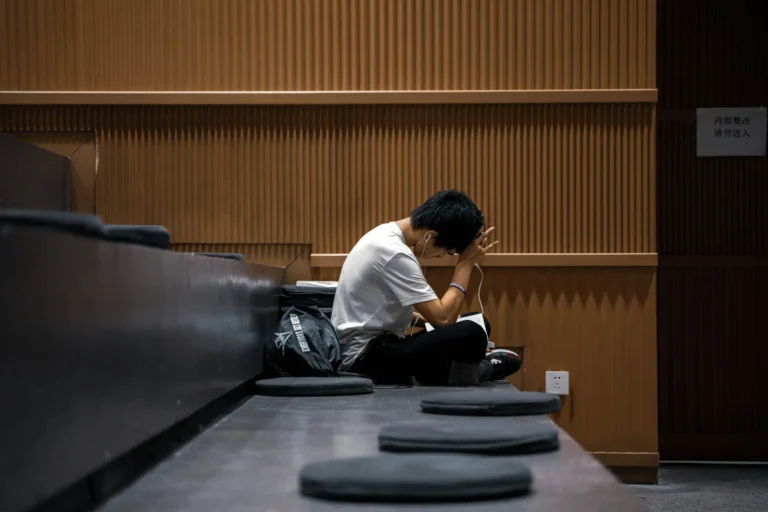
You make an awkward comment in a conversation. Nobody reacts much. The conversation moves on, everyone goes home, and realistically, the other people forget about it within minutes.
Then, three hours later, your brain decides it is time for a replay.
Why did I say that?
Did they think that was weird?
I should have said something else.
Sometimes these memories even return years later, seemingly out of nowhere.
This tendency to mentally revisit uncomfortable social interactions has a name in psychological research: post-event processing. It refers to repetitive thinking about how a social interaction went, often with a particular focus on perceived mistakes or negative impressions.
Although post-event processing has been studied most extensively in social anxiety, occasionally replaying awkward experiences is not unusual. The interesting question is why the brain keeps returning to an event that is already over.
Your Brain Likes to Review Social Experiences
Humans are deeply social.
For most of human history, maintaining relationships and belonging to a group had important consequences for safety, cooperation, and access to resources. As a result, information about how people perceive us can carry considerable psychological importance.
After a socially meaningful event, the brain may continue reviewing what happened:
- Did I say the right thing?
- How did they react?
- Did I embarrass myself?
- What should I do differently next time?
Some reflection can be useful. Reviewing an interaction can help us learn from mistakes and adjust our behavior.
The problem occurs when reflection becomes repetitive, increasingly negative, and no longer produces useful information.
Researchers describe post-event processing as persistent, self-focused thinking that happens after a socially evaluative experience. Rather than simply remembering what happened, someone may repeatedly analyze their performance and focus disproportionately on moments they believe went badly.
The Memory May Become More Negative With Every Replay
One reason awkward experiences can feel worse afterward is that memory is not a perfect recording.
Each time we remember an event, we reconstruct parts of it.
Post-event processing may influence that reconstruction.
A recent scoping review of research on post-event processing found that it is associated with more negative memories of social events and increasingly negative evaluations of one’s own performance.
Experimental research illuminates one pathway. In a study examining memory for feedback after a speech, people higher in social anxiety showed memory biases in how they later recognized feedback about their own performance. Post-event processing helped explain the relationship between social anxiety and memory for negative feedback.
In other words, repeatedly reviewing an awkward experience does not necessarily give us a more objective understanding of it.
Sometimes it does the opposite.
The original event may have lasted ten seconds, but hours of analysis afterward can make that small moment feel disproportionately important.
Self-Focused Attention Can Feed the Replay

Photo by Milada Vigerova on Unsplash
Another important factor is where attention is directed during the interaction itself.
Imagine giving a presentation while thinking:
- My voice sounds strange.
- My face is probably red.
- Everyone can tell I’m nervous.
Instead of focusing primarily on the conversation or audience, attention becomes directed inward.
Research suggests that this kind of self-focused attention may contribute to later post-event processing.
As a result, our memory of the interaction may become heavily influenced by how we *felt* rather than by what other people actually observed.
Feeling embarrassed, for example, does not necessarily mean that you looked embarrassed.
Feeling awkward does not mean everybody thought you were awkward.
But when internal sensations dominate our attention, they can become part of the evidence our brain uses when reconstructing the event.
Why Performances Can Be Especially Replay-Worthy

Photo by Campaign Creators on Unsplash
Not every social interaction produces the same amount of post-event thinking.
Interestingly, the 2025 scoping review found that post-event processing appears to occur more frequently following performance situations than ordinary conversations.
That might include:
- giving a presentation
- speaking in a meeting
- interviewing for a job
- answering a question in class
- performing in front of others
- being introduced to a new group
These situations contain something particularly powerful: evaluation.
When we know other people may be judging our performance, small mistakes can feel more significant.
A sentence that would barely register during a casual conversation can suddenly feel enormous when spoken in front of twenty people.
Your Brain May Be Trying to Prevent the Next Awkward Moment
There is also a potentially useful reason for replaying uncomfortable situations. The brain constantly tries to predict what will happen next. Reviewing previous experiences can help improve those predictions. After an awkward interaction, thinking about what happened might help you decide:
At that point, the review has served a purpose. But post-event processing can continue long after useful problem-solving has ended. Instead of generating a new strategy, the brain simply repeats the same questions.
- Why did I do that?
- Why did I do that?
- Why did I do that?
That distinction separates reflection from rumination.
Reflection can produce information.
Rumination produces repetition.
Why the Awkward Moment Feels Bigger to You Than Everyone Else
There is another reason these memories can feel disproportionately important: you experienced the event from the inside.
You remember what you were thinking.
You remember the sudden rush of embarrassment.
You remember noticing your voice change or losing your train of thought.
Other people do not usually have access to that information.
They experienced only the outside version of the interaction while they were also busy thinking about themselves.
This creates an asymmetry.
To you, the moment may contain an entire internal story.
To someone else, it may have been a five-second interaction they barely registered.
That does not mean embarrassing social experiences never matter. But our internal experience of them can easily exaggerate how visible or memorable they were to everyone else.
The Replay Can Change How You Approach Future Situations
Post-event processing does not necessarily end with the memory itself. Research on social anxiety suggests that repeatedly reviewing previous social experiences can influence expectations about future interactions.
If you repeatedly remember a presentation as a disaster, the next presentation may begin with the expectation: I’m bad at this.
That expectation may increase anxiety, self-monitoring, and avoidance, making another round of post-event processing more likely afterward.
Researchers therefore describe post-event processing as one mechanism that may help maintain social anxiety over time.
A cycle can develop:
Social situation → self-focused attention → perceived mistake → replaying the event → more negative memory → greater anxiety before the next situation
The memory of the previous interaction becomes part of the prediction for the next one.
How to Interrupt the Replay

Photo by Aaron Burden on Unsplash
Trying to force yourself to never think about an awkward moment again is not realistic. Instead, change how you respond when the replay starts.
Ask whether there is actually anything left to learn
If there is a useful lesson, identify it. → Next time I’ll slow down before answering.
Once you have extracted useful information, continuing to replay the event is unlikely to add anything.
Separate feelings from evidence
Instead of → “I felt incredibly awkward, so everyone must have noticed.”
Try → “I felt awkward. What evidence do I have about what everyone else thought?”
Reconstruct the whole interaction
Embarrassing memories often zoom in on one moment while ignoring everything around it.
Instead of remembering only the sentence you stumbled over, remember the entire conversation.
What happened before?
What happened afterward?
Did people continue talking normally?
Broadening the memory can help restore context that repetitive thinking tends to remove.
Shift attention outward
If you notice yourself becoming highly self-focused during social situations, redirecting attention toward the conversation, environment, or other person may reduce the amount of internal information available for later overanalysis.
The Takeaway
The brain may initially be trying to learn something useful. But there is a point where reviewing becomes replaying. And sometimes the most accurate conclusion after an awkward interaction is also the simplest:
It happened.
You survived it.
And everyone else was probably more occupied with their own awkward moments than yours.
Further Reading
- Post-event rumination and social anxiety: A systematic review and meta-analysis.
- Effect of self-focused attention on post-event processing in social anxiety.
- Post-event processing in social anxiety: A scoping review.
- Cognitive processes in social anxiety: The effects of self-focus, rumination and anticipatory processing.
- Ruminative coping and post-event processing in social anxiety.