
Most of us think of identity as something private.
Who am I?
What do I like?
What do I believe?
What kind of person am I?
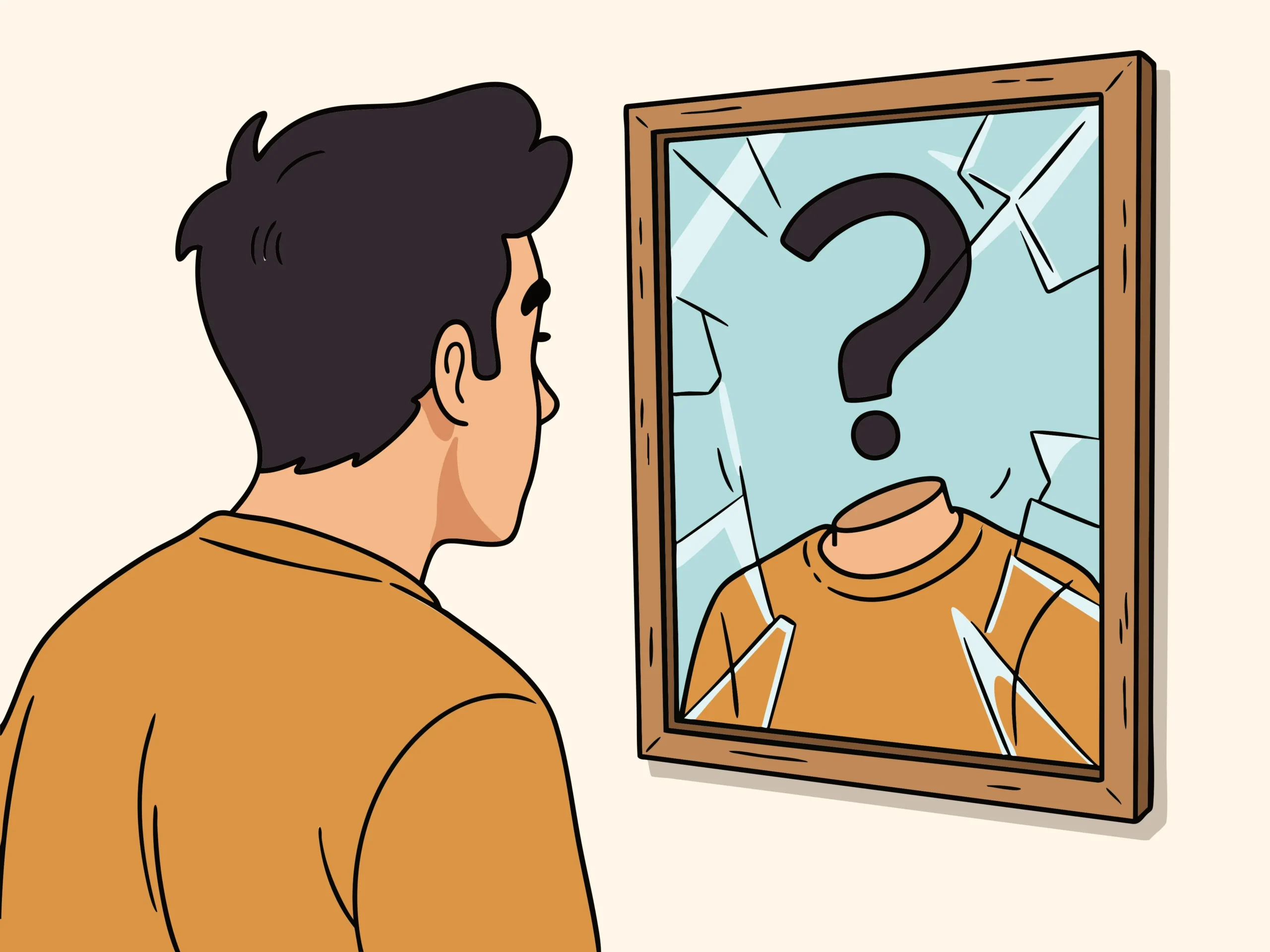
Illustration by Fast Ink on Unsplash
But social psychology suggests that the self is not built in isolation. The people around us partly shape who we become, their reactions, expectations, judgements, and the way we imagine they see us.
The literature calls this phenomenon the Looking-Glass self. First introduced by sociologist Charles Horton Cooley in 1902, the theory suggests that people develop part of their self-concept by imagining how they appear to others, interpreting how others judge them, and then forming feelings about themselves in response.
In simple terms: other people can become mirrors.
And over time, we may start to live as if these mirrors are telling the whole truth.
The Social Mirror
The looking glass self does not mean we have no inner identity. It means our sense of self is partly shaped through social reflection.
A child repeatedly called “too sensitive” may grow into an adult who mistrusts their emotions. A person praised only for achievement may learn to feel valuable only when productive. Someone who was judged for their body may begin to experience their body as a problem to fix. Someone who was always “the strong one” may struggle to admit when they need support.
The mirror becomes internal.
Research on reflected appraisals supports this idea. Reflected appraisals refer to the beliefs people hold about how others see them. These perceived evaluations can influence self-concept, mood, and self-esteem. A study found that reflected appraisals vary across everyday contexts and are associated with mood changes, suggesting that how we think others view us can affect how we feel about ourselves in real time.
Other research shows that reflected self-appraisals may be remembered differently depending on relationship closeness. In one study, people showed better memory for reflected appraisals from romantic partners than from friends or classmates, suggesting that evaluations from emotionally important people may carry special weight.
This matters because self-concept is not solely psychological. The way we see ourselves can influence how we move through the world, how safe we feel in relationships, and how much stress we carry in the body.
When being Seen becomes Stressful
Being seen can feel beautiful when it comes with safety, acceptance, and belonging.
But being watched, judged, critiqued, or evaluated can activate stress.
Research on social evaluation threat shows that situations involving possible negative judgement from others can trigger psychological stress responses, including cortisol and cardiovascular reactivity. In a controlled study, social evaluation threat produced greater cortisol reactivity than a non-evaluative stressor, supporting the idea that the body responds strongly when the “social self” feels judged or exposed.
This fits with social preservation theory, which proposes that threats to social workaholic can activate stress biology. In a study on shame, social self-esteem, and cortisol, researchers found that cortisol increases were greater among participants who experienced stronger increases in shame and stronger decreases in social self-esteem during social self threat.
This means the fear of being disliked, rejected, embarrassed, or misunderstood is not “just in your head.” Social evaluation can become a body experience.
It may show up as:
- tight shoulders
- shallow breathing
- stomach tensions
- racing thoughts
- sweating
- people-pleasing
- fatigue after social interactions
- difficulty relaxing when you are not performing
The body may start living under the question: “How am I being perceived?”
The Hidden Cost of Performing

Photo by Gilles Lambert on Unsplash
The looking-glass self becomes especially important in a culture where people are constantly visible.
Social media, workplace pressure, wellness culture, beauty standards, family expectations, and professional identity can all create mirrors. Some are supportive. Others are exhausting.
A person may start performing calmness, success, attractiveness, discipline, happiness, or “healing” even when their body is quiet and overwhelmed.
This can create a painful split between the inner self and presented self. Research on social media self-presentation suggests that online self-presentation, feedback-seeking, and upward social comparisons are linked with mental health concerns, especially among adolescents and young adults. One study noted that aspects of digital self-presentation have been associated with worse mental health and called for more research into how these patterns unfold over time.
A systematic review on social media and adolescent mental health also found a modest but statistically significant association between social media use and depressive symptoms, while emphasizing that causality is still unclear.
This does not mean social media is always harmful. It means that constantly managing how we appear can become draining, especially when the image we maintain does not mirror how we actually feel.
Wellness culture can sometimes intensify this. Instead of asking, “What does my body need?” we may start asking:
- Do I look healthy enough?
- Am I disciplined enough?
- Am I healing fast enough?
- Do other people think I have my life together?
At that point, wellness becomes another mirror to perform for.
Shame: When the Mirror Turns Harsh
One of the most damaging mirrors is shame.
Shame does not simply say, “I made a mistake.” It says, “Something is wrong with me.”

Photo by Nik Shuliahin 💛💙 on Unsplash
A meta-analysis on shame and self-esteem found a strong negative association between shame and self-esteem, meaning that higher shame tends to be linked with lower self-worth.
This is important for healing because shame often makes people hide.
They hide symptoms.
They hide cravings.
They hide pain.
They hide emotional overwhelm.
They hide the parts of themselves they believe are unacceptable.
But what is hidden is often harder to heal.
For holistic practitioners, this matters deeply. A client’s symptoms may not only be biological. They may also be wrapped in years of social messaging: “Don’t be dramatic.” “Push through.” “You’re too much.” “You should be over this by now.” “Real success means never needing help.”
These messages can become internal mirrors that keep the body bracing.
The Body Responds to Identity
From a holistic perspective, identity is not abstract. It can shape behavior, stress, posture, breath, sleep, and emotional regulation.
If someone believes they must always be strong, they may ignore fatigue.
If someone believes their body is shameful, they may struggle to inhabit it peacefully.
If someone believes rest is laziness, they may override recovery signals.
If someone believes they are only lovable when useful, they may live in chronic overextension.
The body receives these beliefs as instructions.
This is where the Looking-Glass Self connects with biosignals. The body constantly sends information: tension, pain, fatigue, breath changes, gut signals, heart rhythm, emotional shifts, and nervous system cues. Interoception research describes this as the process by which the nervous system senses, interprets, and integrates signals from inside the body. These internal signals help support emotion, self-awareness, and regulation.
But if a person has learned to prioritize external approval over internal signals, they may stop trusting what the body is trying to say. Healing may require turning down the volume of the social mirror and turning up the volume of the body’s own signals.
Reclaiming the Mirror
The goal is not to stop caring what others think entirely. Humans are social beings. We have evolved to be shaped by connection.
But not every mirror deserves authority.
Some people reflect us with compassion, honesty, and care. Others reflect their own fears, projections, biases, or expectations. Part of healing is learning to ask: “Whose mirror have I been living inside?”
A healthier mirror might come from a supportive practitioner, a trusted friend, a safe community, or a relationship where you do not have to perform to be accepted.
It may also come from the body itself.
The breath can say, “This is too much.”
The stomach can say, “I do not feel safe here.”
The shoulders can say, “I have been carrying too much.”
The fatigue can say, “I need recovery, not more pressure.”
These signals are not failures. They are information.
Final Thoughts
The Looking-Glass Self reminds us that identity is relational. We become ourselves, in part, through the reflections we receive from others.
But healing may require asking whether those reflections were ever accurate, kind, or complete.
Maybe you are not “too sensitive.”
Maybe your body learned to detect subtle changes because it had to.
Maybe you are not lazy.
Maybe your nervous system is exhausted.
Maybe you are not broken.
Maybe you have been living inside mirrors that were never built to show your whole self.
Wellness is not only about optimizing the body. It is also about reclaiming the self from the expectations, labels, and judgments that taught the body to brace.
Sometimes healing begins with a new question:
Who am I when I am no longer performing for the mirror?
Further Reading
- Mirroring minds: assessing the relative stability of self-appraisal and reflected appraisal in daily life
- See me through my eyes
- Acute stressors and cortisol responses: a theoretical integration and synthesis of laboratory research
- The Cost of Impression Management to Life Satisfaction: Sense of Control and Loneliness as Mediators
Disclaimer:
If shame, self-criticism, or difficulty inhabiting your body feel persistent or overwhelming, working with a licensed therapist can help. This article is educational and isn’t a substitute for mental health care.
This information is for educational purposes only and does not constitute professional medical advice. Always consult a healthcare professional before incorporating any new therapy into your practice. Thera Wellness is a wellness technology and is not intended to diagnose, treat, cure, mitigate, or prevent disease or any condition.
Do you want to see all the updates?
👉 Follow us on Instagram and Facebook and never miss a thing!